On-demand webinar coming soon...


On-demand webinar coming soon...

Blog

AI Governance Moves From Side Hustle to Enterprise Foundation

Businesses are struggling because traditional governance models can't keep pace with AI 

Bex Evans
Director, Product Marketing
July 23, 2026

Person working at a modern desk, using a laptop and smartphone with a notebook nearby, plants in the background, and abstract color overlays suggesting a digital workspace.

What began as a handful of machine learning models managed by specialized data science teams has rapidly evolved into a sprawling ecosystem of generative AI applications, embedded AI capabilities, autonomous agents, and third-party services. 

AI is no longer confined to research labs or innovation teams; it’s part of and relied on by everyday business operations, with employees across every function building, buying, and using AI to improve productivity and accelerate decision-making.

This shift is now an opportunity. Organizations are using AI to streamline operations, improve customer experiences, and unlock value at a pace that would have been difficult to imagine only a few years ago. 

But there’s a cause and effect: AI has become significantly more difficult to govern. Business users can create AI-powered workflows without writing code. Software vendors are building AI into existing platforms. Agents are beginning to execute multi-step tasks with increasing levels of autonomy. Models are updated continuously, regulations continue to evolve, and new use cases emerge almost daily. 

Key Takeaways

  • AI adoption has expanded beyond traditional machine learning to include generative AI, embedded AI, autonomous agents, and business-led AI development. 
  • Traditional governance approaches were not designed to keep pace with the speed, scale, and continuous evolution of modern AI systems. 
  • AI governance is evolving from a periodic compliance activity into an operational capability embedded throughout the AI lifecycle.  
  • Modern AI governance platforms provide centralized visibility, operational workflows, and continuous assurance that help organizations scale AI responsibly. 
  • Organizations that operationalize AI governance can innovate faster while strengthening trust, accountability, and regulatory readiness. 

The challenge facing executive teams is no longer whether they should adopt AI. That decision has largely been made. The question now is whether their governance capabilities have evolved quickly enough to keep pace with the technology itself.

For many organizations, the answer is no.

The governance models that have served enterprises well for decades were designed for slower-moving technologies with predictable development lifecycles. AI has fundamentally changed those assumptions. As organizations move from isolated AI projects to enterprise-wide AI adoption, governance must evolve from a periodic oversight function into an operational capability that enables innovation while maintaining trust, accountability, and control.


AI Has Outgrown Traditional Governance 

Only a few years ago, governing AI primarily meant reviewing internally developed machine learning models before they entered production. Those models were typically built by centralized teams following structured development processes. Governance focused on documentation, validation, and periodic reviews that aligned well with established risk management practices.

Today's reality looks dramatically different. 

AI touches more systems, suppliers, and business processes than governance programs were designed for. Employees interact with embedded AI features inside software they already use every day. Autonomous agents are beginning to make decisions, coordinate activities, and execute business processes with limited human intervention.

In many organizations, AI adoption has become decentralized. Instead of a single team driving implementation, AI initiatives now originate across legal, marketing, HR, finance, customer support, engineering, procurement, and virtually every other business function. 

This democratization of AI is one of the technology's greatest strengths. It allows organizations to move faster, empowers employees to solve business problems directly, and accelerates digital transformation. But it also introduces new governance challenges. Organizations must understand what AI is being used, how it works, and what rules apply. Without that visibility, governance becomes reactive instead of proactive.


Existing Governance Models Are Reaching Their Limits 

Most enterprises are not starting from scratch. They have functions that oversee technology, risk, compliance, privacy, and security. These remain essential, but they were not designed to govern the speed, scale, and complexity of modern AI.

In Financial Services, model risk management has traditionally focused on validating predictive models before deployment and proving their compliance. Governance, risk, and compliance programs excel at documenting policies, assigning controls, and demonstrating regulatory compliance. Security teams protect infrastructure, while privacy teams oversee responsible data use. Each discipline addresses an important piece of the puzzle.

The challenge is that AI cuts across all of them simultaneously.

A single agent may introduce privacy concerns, cybersecurity risks, intellectual property considerations, third-party vendor dependencies, regulatory obligations, and evolving model behavior—all while being deployed and updated continuously. Managing these interconnected risks through disconnected governance processes often results in duplicated effort, inconsistent decisions, and slower innovation. 

Many organizations also continue to rely on manual governance processes that simply cannot scale. AI inventories maintained in spreadsheets quickly become outdated. Approval workflows conducted through email create inconsistent documentation and limited visibility. Risk assessments performed only during initial deployment provide little insight into how AI systems behave months later after prompts have changed, models have been updated, or new data sources have been introduced.

The issue is not that these governance practices are ineffective. They were just built for a different operating environment.
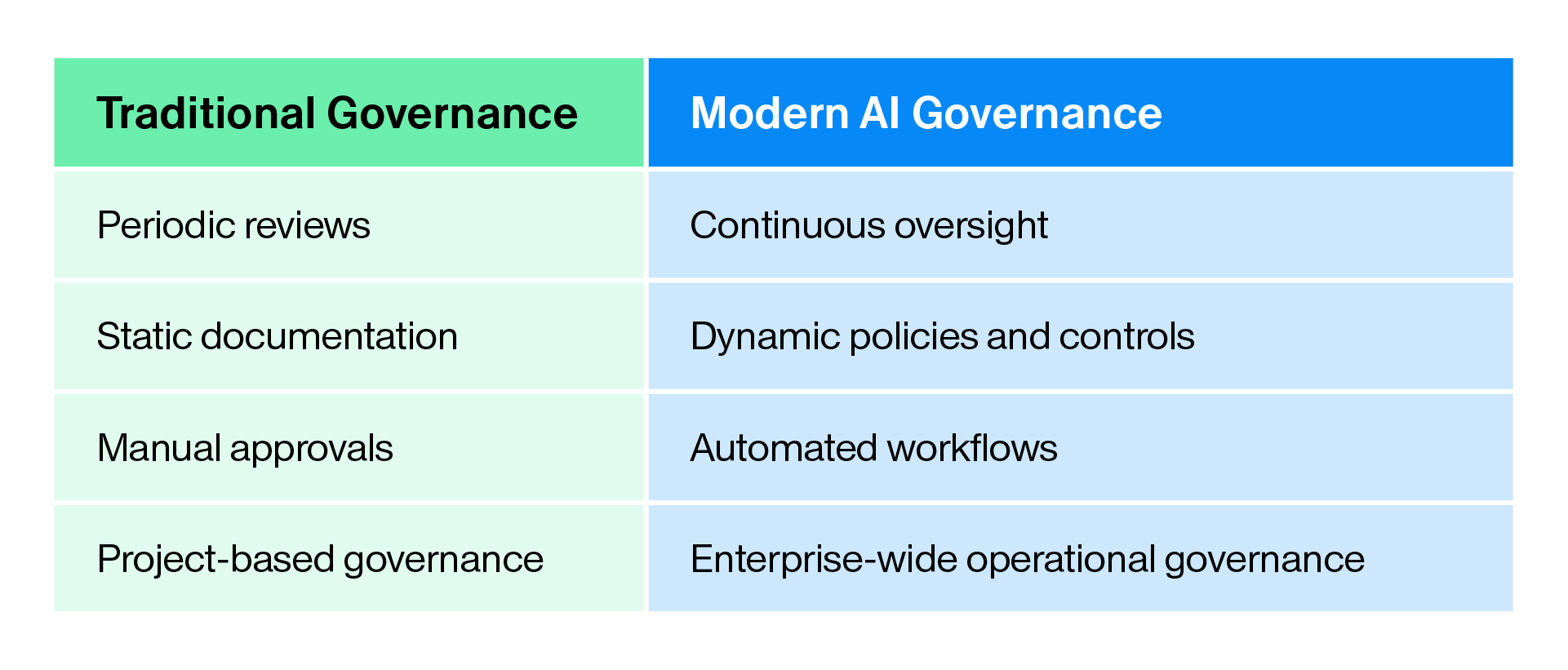

Comparison table showing how governance has evolved from traditional governance to modern AI governance: periodic reviews become continuous oversight, static documentation becomes dynamic policies and controls, manual approvals become automated workflows, and project-based governance becomes enterprise-wide operational governance.

Governance Is Becoming an Operational Capability

Perhaps the biggest shift organizations are experiencing is that governance is not something that only happens before deployment. It must become part of how AI is managed every day.

Historically, governance was often viewed as a checkpoint. Teams completed documentation, obtained approvals, and moved projects into production. Once deployed, oversight became far less frequent unless an audit or regulatory review occurred.

AI doesn’t behave that way.

Foundation models evolve. Prompts change. New retrieval sources are connected. Business users create additional workflows. Vendors release new capabilities. Autonomous agents adapt their behavior based on changing objectives and environmental inputs. The AI system approved six months ago may no longer behave like the one operating today.

This reality requires organizations to think differently about governance. Runtime behavior must be continually assessed against policy, risk frameworks, and controls, with information moving in both directions between governance and operations.

Governance must move from oversight
to runtime.

This operational approach does not slow innovation. Quite the opposite. When governance becomes embedded into the way AI is developed, deployed, and monitored, organizations can make decisions more consistently, approve new use cases more efficiently, and reduce uncertainty for both technical and business teams.


What to Expect From an AI Governance Platform

As AI adoption accelerates, many organizations are recognizing that existing governance tools alone are not enough. Just as cybersecurity, privacy, and identity management evolved into dedicated operational platforms, AI governance is emerging as its own enterprise capability.

That does not mean replacing existing investments. Instead, AI governance platforms provide the operational layer that connects governance policy with the day-to-day execution of AI across the enterprise.

The first capability organizations should expect is comprehensive visibility. It’s impossible to govern AI that cannot be discovered or understood. A modern governance platform should provide a centralized inventory of AI systems across the organization, including internally developed applications, foundation models, embedded AI services, autonomous agents, and third-party AI tools. More importantly, that inventory should capture ownership, intended purpose, deployment status, associated risks, and supporting documentation so stakeholders share a common understanding of the organization's AI landscape.

Visibility alone, however, is not governance.

Organizations also need a way to operationalize governance through consistent workflows and decision-making. AI use cases should move through structured intake processes, risk assessments, approvals, policy validation, and evidence collection without relying on disconnected process or manual documentation. 

Governance should become part of existing development and business processes rather than a separate administrative exercise. With governance directly inside operational workflows, organizations can improve consistency while reducing friction for the teams responsible for delivering AI solutions.

Finally, governance must extend beyond deployment. AI systems require continuous assurance throughout their lifecycle. Organizations need ongoing monitoring that identifies changing risks, tracks policy adherence, supports evolving regulatory obligations, and provides defensible evidence for audits and executive reporting. Continuous governance creates confidence that AI systems remain aligned with organizational expectations long after they enter production.

Together, these capabilities transform governance from a reactive compliance exercise into an operational discipline that supports responsible AI at enterprise scale.


AI Governance Enables Innovation

Discussions around AI governance often focus on risk, regulation, and compliance. Those topics are undeniably important, but they tell only part of the story.

The organizations realizing the greatest value from AI are not necessarily those willing to accept the most risk. They are the ones that have created enough confidence in their governance processes to move quickly without sacrificing accountability.

Strong governance accelerates innovation because it creates clarity. Business teams understand how to introduce new AI use cases. Technology teams know which controls are required. Legal, compliance, privacy, security, and risk functions operate from a shared framework instead of conducting separate reviews. 

Governance also improves consistency. Rather than making each AI decision independently, organizations establish repeatable processes that scale alongside AI adoption. As the number of models, applications, agents, and embedded AI capabilities grows, governance becomes an organizational capability rather than an organizational bottleneck.

Perhaps most importantly, mature governance helps organizations demonstrate trust. Transparency around how AI systems are deployed and managed is becoming more expected. Organizations that can provide clear evidence of responsible governance will be better positioned to earn stakeholder confidence while adapting to an evolving regulatory landscape.

In this sense, governance should not be viewed as the cost of innovation. It is the infrastructure that allows innovation to scale.


The Next Phase of Enterprise AI

Enterprise AI is still in its early stages, yet one trend is already becoming clear: AI is everywhere. As that ubiquity continues, governance will increasingly resemble other enterprise disciplines such as cybersecurity, privacy, and identity management—capabilities that operate continuously, span the entire organization, and enable the business to move forward with confidence.

Organizations that fail to evolve governance will not realize the maximum potential of their AI strategy. Those that establish operational governance today will be better positioned to adapt as new AI technologies emerge, regulatory expectations evolve, and business teams continue to innovate.

Ultimately, the organizations that create the greatest long-term value will be the ones capable of governing AI consistently across the enterprise — creating the trust, accountability, and operational discipline needed to transform innovation into lasting business advantage.

Learn more about AI Governance as a platform and why OneTrust was recognized as a Visionary in Gartner’s first-ever Magic Quadrant for AI Governance solutions


Frequently Asked Questions


These programs remain essential but were designed for technologies with slower development cycles and more predictable behavior. Modern AI introduces dynamic models, autonomous agents, embedded AI, and decentralized adoption that require continuous oversight, operational workflows, and runtime governance capabilities.

An AI governance platform provides a centralized operational layer for managing AI across the enterprise. It helps organizations discover AI systems, assess and manage risk, automate governance workflows, enforce policies, monitor AI over time, and maintain audit-ready evidence across the AI lifecycle.

No. While regulatory compliance is an important outcome, effective AI governance also enables organizations to accelerate AI adoption by improving visibility, standardizing decision-making, reducing operational friction, and increasing confidence across business and technical teams.

AI governance is inherently cross-functional. Successful programs bring together legal, compliance, privacy, security, risk, technology, and business leaders through shared processes and operational governance rather than assigning ownership to a single department.

Organizations should establish governance capabilities that are scalable, operational, and adaptable. As AI technologies continue to evolve, governance must provide continuous visibility, risk management, policy enforcement, and evidence collection across an increasingly diverse AI ecosystem.